
Notes from SOAR 2026: Eastern Kentucky Is Building the Workforce Before the Megawatts
This week more than 1,200 leaders gathered at the Corbin Arena in southeastern Kentucky for the SOAR Summit — Shaping Our Appalachian Region, the nonprofit that serves the 54 Appalachian Regional Commission counties of Eastern Kentucky. We spent two days in the exhibit hall, the sessions and the closing plenary. These are our notes, and our read on what the region is building. Everything below comes from public exhibits, printed materials and sessions.
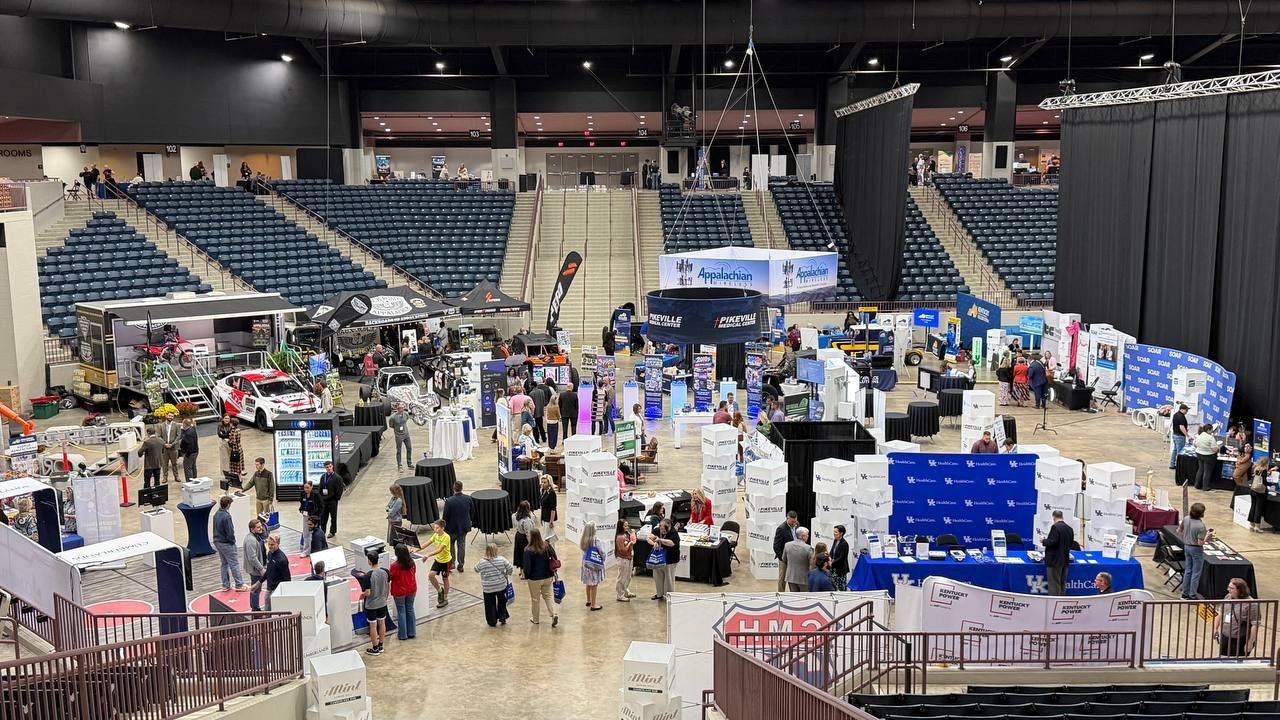
Who showed up says a lot
The Summit was presented by the Appalachian Regional Commission and Appalachian Wireless, an East Kentucky Network company. The exhibit hall was presented by ARH, the 14-hospital Appalachian Regional Healthcare system. On the floor, a regional utility stood next to a rural fiber operator; hospital systems next to universities and community colleges; union carpenters and millwrights next to area development districts — and, in one corner, rally cars promoting a motorsport-and-overlanding tourism project.
This is not a region waiting for one big employer. It is assembling the pieces of a broader economy at the same time.
Breadth is the signal. When infrastructure, healthcare, education and tourism are built in parallel, a place becomes investable for the long term instead of dependent on a single project.
The wires are already there — the question is trust
Eastern Kentucky is often described as under-connected. The exhibit hall argued otherwise. East Kentucky Network — the network built by the region’s rural telephone cooperatives and companies, and the parent of Appalachian Wireless — showed a 400-mile redundant fiber ring, more than 7,500 combined fiber miles, and a 16,700-square-foot data center with transport to hubs in Chicago and Ashburn, “and soon, Atlanta.”
On power, Kentucky Power, an AEP company, serves about 163,000 customers in all or part of 20 eastern Kentucky counties, runs the 295-megawatt natural-gas Big Sandy plant at Louisa, and has announced plans for a 760-megawatt combined-cycle plant at the same site. In the sessions, a “Nuclear Ready” workshop with the Kentucky Nuclear Energy Development Authority — created by the legislature in 2024 — walked communities through positioning for the next generation of energy projects.
Fiber, gas and a nuclear conversation are all on the table. What is scarce is not the physical input — it is a project that a community understands and wants.

“Not All Data Centers Are The Same”
The most revealing exhibit was a poster. Under that headline, East Kentucky Network contrasted its roughly 1.5-megawatt regional facility with hyperscale projects that “may require 50 to 100+ megawatts,” and stressed 6–10 skilled local jobs, local customers — schools, hospitals, 911 centers — and growth “coordinated with local utilities, governments and community stakeholders.” Its tagline: “Responsible. Transparent. Local.”
When a local operator feels it has to explain to its own community what kind of data center it is, the binding constraint is no longer fiber or even power. It is social license. Projects that arrive with transparency, local benefit and a plan that fits the region will move; projects that arrive as black boxes will meet resistance.
Retooling the region’s industrial know-how
This was the strongest part of the floor. Community and technical colleges did not just hand out brochures — they brought working equipment.
• Somerset Community College (KCTCS) brought the industrial robot behind Kentucky’s first concrete 3D-printing training program, surrounded by printed wall segments — and a humanoid robot. The college is also hosting the Geothermal Drillers Association’s field-technician readiness certificate in January 2027.
• Hazard Community & Technical College showed a collaborative robot and its manufacturing engineering technology program, alongside certified fiber-optic technician training and a mobile solar-and-electrical training rig.
• eKAMI, the eKentucky Advanced Manufacturing Institute in Paintsville, displayed precision-machined parts from its NIMS-accredited program; its first class in 2017 was built around former coal-industry workers.
• Morehead State University’s Space Science Center reminded visitors that eastern Kentucky builds nanosatellites and runs a 21-meter ground station that is part of NASA’s Deep Space Network.
• Eastern Kentucky University showed computer-science tracks in AI, cybersecurity and digital forensics; Northern Kentucky University recruited for engineering-technology and geology graduates; and Rajant — which opened a 9,600-square-foot plant in Morehead in 2017 staffed largely by Morehead State graduates and grew it past 48,000 square feet by 2021 — showed plans on stage for an expansion to 150,000 square feet in total.
• Building-trades unions — the Central Midwest Regional Council of Carpenters and a Kentucky millwrights local — recruited under a banner that read “Setting the Pace in Energy.”
The pattern is consistent: drilling, machining, electrical and heavy-equipment skills that once served coal, oil and gas are being redirected toward robotics, advanced manufacturing, fiber, geothermal and power construction.
The scarce input in energy and digital infrastructure is increasingly people — electricians, millwrights, fiber technicians, operators. A region already training them, locally and at scale, holds an advantage that does not show up on a map of substations.

Measured on the spot
University of the Cumberlands ran a live “How AI-Literate Are We?” assessment at its booth. By midday Thursday, 34 participants from nine Kentucky counties and two other states had taken it. The average score was 85.7 out of 100; 65% rated “AI-literate” or higher and 59% “fluent” or “strategic.” The strongest dimension was evaluating AI (96.1); the weakest was human judgment (66.7). As the screen itself noted, the results describe the people who took part, not the wider region.
A small, self-selected sample — but a telling one. The tools are being adopted; the harder skill is judgment about when and how to use them. That is where training will matter most.
Downtowns, housing and child care are infrastructure too
Some of the most practical ideas were about rebuilding places, not just recruiting employers. Rebuilding Appalachia, a veteran-led nonprofit in Barbourville, presented its first project: the 1910 First State Bank building, being converted into two zero-rent commercial spaces for startups, two workforce apartments and 1,600 square feet of civic space. Kentucky Highlands Investment Corporation spoke on low-rate lending to young businesses, and sessions covered child care, rural health and recovery — the everyday infrastructure that decides whether workers stay.
Any large project that needs a local workforce will depend on housing, child care and healthcare. The strongest projects will treat them as part of the build, not someone else’s problem.

“We’re forgetting about county lines”
Friday’s principal-officer plenary turned the floor’s themes into a political argument. Kentucky Senate President Robert Stivers framed eastern Kentucky as a single labor market: “We’re forgetting about county lines. We’re starting to talk about this as a region.” He pointed to energy-production work in Bell County that he said will need some 2,000 workers — drawn, he stressed, from the region.
Congressman Hal Rogers, who co-founded SOAR as a response to the collapse of coal, walked through a decade of hard infrastructure: the Cumberland Gap tunnels, flood-diversion tunnels at Harlan, and broadband expansion driven from the Center for Rural Development in Somerset. “SOAR gives us a chance to pull together about bigger goals,” he said.
Governor Andy Beshear opened with the region’s history — “Eastern Kentucky has fueled our nation through two world wars, powered the Industrial Revolution, and helped build the greatest middle class this world has ever seen” — then cited $54 billion in private investment and some 71,000 jobs announced during his tenure, average incentivized wages above $30 an hour, flood-recovery housing built on high ground with solar roofs, and investments in career and technical education and child care: “we’re also investing in our people and our workforce.”
The keynote, geopolitical strategist John Sitilides, carried the only data-center chart of the morning: a BloombergNEF slide titled “Gas and Coal Will Fuel Most New AI Data Center Power Demand,” projecting that 57% of global data-center power in 2035 will come from gas and coal.
What went unsaid matters. None of the three elected officials talked about data centers or AI; they talked about jobs, wages, workforce, roads, broadband and health. In eastern Kentucky the political language of growth is people, not megawatts — and any energy or digital project that wants support here will have to speak it.
Eastern Kentucky is not waiting to be discovered. It already has fiber, power and — most importantly — institutions retraining people for the industries that are coming. The next wave of energy and digital infrastructure will be won by projects that arrive with a workforce plan and a community plan, not just a megawatt plan. That is where Moiseus looks.
This material is for general informational purposes only. It is market commentary and reflects our own views. Observations are drawn from public exhibits, printed materials and sessions at the SOAR Summit 2026; figures are as presented by the organizations or their public websites. Mention of an organization does not imply any relationship with, or endorsement of, Moiseus Capital. This is not an offer to sell or a solicitation of an offer to buy any security, and it is not investment advice. Moiseus Capital Corp is not currently offering securities. All trademarks belong to their respective owners.