
Inside PJM’s Queue: Notes from Jason Connell at Experience POWER
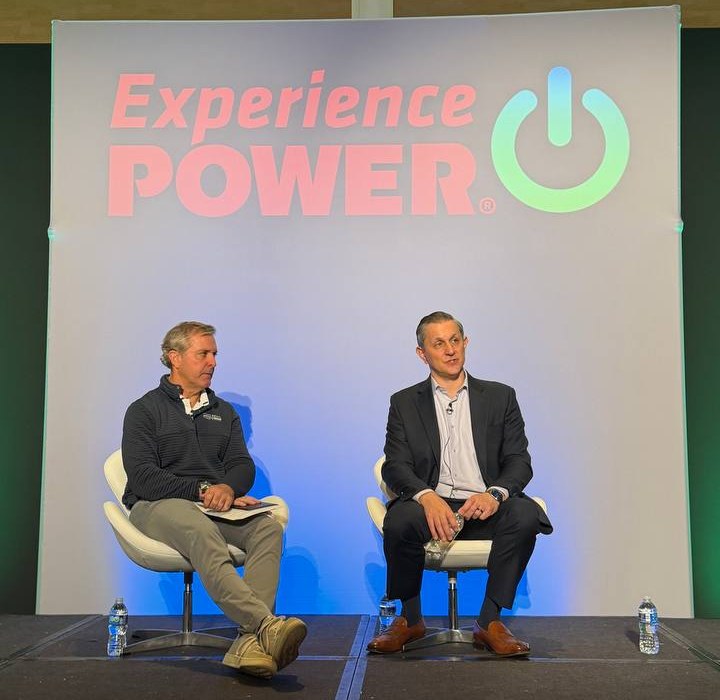
At Experience POWER in Washington, D.C. this week, Jason P. Connell, Vice President of Planning at PJM Interconnection, spent a session answering developers’ questions about the largest grid operator in North America. These are our notes and our read on what they mean. Figures are as stated by the speaker in the session.
The queue is filtering itself down to the serious
PJM’s first cycle under its reformed process opened with roughly 220 GW of requests — more than the approximately 190 GW of capacity installed on the system today. Readiness deposits, site-control checks and a deficiency review removed about 100 projects. Then PJM published the study model 30 days before studies began, so developers could estimate their own upgrade exposure, and roughly another 100 withdrew. Just under 170 GW is now moving forward. By Connell’s account, the mix is dominated by natural gas (about 100 GW at submission) and battery storage (about 60 GW), with solar, wind and some nuclear making up the rest.
Money at risk and early cost visibility are doing what years of queue reform could not: separating projects that will be built from projects that will only be filed.
Demand isn’t shrinking — it’s arriving later
PJM screens every large-load submission above roughly 50 MW before deciding how much of it goes into the forecast. Over the past two years, Connell said, the demand curve has not come down where it ends up, but it has shifted to the right: load is arriving somewhat more slowly than first expected, which buys time for transmission and generation to catch up. Asked whether the supply gap is temporary, he was candid: “If the load continues to grow at this pace, we’re going to be lagging for a substantial amount of time.”
A delayed curve is not a flatter one. The scarcity window for deliverable power is longer than the hype cycle suggests, not shorter.
Readiness buys speed — and the rules now say so explicitly
The Expedited Interconnection Track targets about 10 months from application to executed agreement, but only for projects with full site control (gen-tie and switchyard included), more money at risk, and a commitment from their state. A separate replacement-generation path lets new units reuse the interconnection rights of a retiring plant at the same substation in under a year, running in parallel to the main queue. Retirements are posted publicly, and PJM offers an online map tool that shows the reliability violations a hypothetical generator would trigger at any point on the grid.
Existing substations and retiring plants are becoming some of the most valuable real estate in the power business. Grid position is an asset you can underwrite.

After the agreement, permitting is what stalls projects
PJM also manages construction milestones after a Generation Interconnection Agreement is signed. According to Connell, the large majority of developer requests to extend milestones come from permitting and siting: changing setbacks and, in some towns, outright moratoriums on certain fuel types. Equipment procurement comes a distant second. When transmission upgrades run late, PJM is increasingly letting projects operate on an interim or curtailable basis instead of waiting.
The interconnection agreement is no longer the finish line. Local permitting has become the binding constraint, and it is won or lost long before the grid studies end.
Proactive transmission is starting to pay back
Because PJM is running out of existing capacity and signed agreements to balance its planning cases, it now plans transmission around generation still in the queue. Connell cited about $24 billion of new transmission approved in recent planning cycles, including new 765-kV lines moving power from west to east. In the second transition cycle, a roughly $12 billion transmission package cut developers’ assigned network-upgrade costs from about $10 billion to about $1.3 billion. Capacity with signed interconnection agreements has grown from 27 GW at the end of 2022 to more than 50 GW.
Upgrade costs are no longer a fixed number assigned to one developer. They increasingly depend on where the regional backbone gets built, so a project’s location relative to planned transmission now drives its economics.
One door for load and generation
Responding to FERC’s show-cause order on serving large loads, PJM is preparing a mid-November filing that would study transmission service for large loads and new generation together in a single cluster, whether or not they are co-located. The goal is a shorter timeline for generators, about 12 months, and upgrade costs assigned to the projects that cause them rather than to existing ratepayers.
If it holds, this is the most important structural change of the cycle: load and generation get studied, priced and scheduled together. Sites that can offer both (land, grid access and a path to generation) stand to benefit most.
PJM’s message was consistent across every question: the system now rewards readiness — money at risk, secured sites, state support, permits in hand — and it is redesigning the process so that load and generation arrive together. The scarce asset is not a place in the queue, but a project that can clear it.
This material is for general informational purposes only. It is market commentary and reflects our own views. Remarks from the Experience POWER session are summarized and paraphrased from our notes; quotations are lightly edited for clarity, and figures are as stated by the speaker and have not been independently verified unless linked. Speaker views are his own and do not imply any relationship with, or endorsement of, Moiseus Capital. This is not an offer to sell or a solicitation of an offer to buy any security, and it is not investment advice. Moiseus Capital Corp is not currently offering securities. All trademarks belong to their respective owners.